As Pixel 10 is about to be released, since we talked about the exclusive offers of Google Store in the last issue, some friends who are not familiar with shipping have left messages, wanting to know how to use the shipping service if the merchant does not provide direct shipping to China.
There are tons of tutorials online about shipping services and shipping companies, and I assumed everyone was familiar with them, but I wasn't surprised someone still asked about them. Considering that applying for overseas bank cards and purchasing contract phones like Pixels and iPhones from overseas carriers often involve shipping companies, even virtual mailboxes and private addresses, and also to complement my overseas tool collection, I decided to discuss this topic.
Let me first give you a disclaimer: I am not a professional, and the following content is my subjective experience and evaluation of various shipping services. Before investing real money, please compare and verify more.
1. Usage Scenarios
In short: when direct mail is not possible, use forwarding.
This may seem like nonsense, but if you think about it carefully, there is a lot of truth to it. Because the purpose of using transshipment is: first, to receive the goods, and second, to save money.
In specific practice, there are different application scenarios for item transshipment:
1. Surface mail
The biggest problem with receiving surface mail internationally is that it can't be tracked and easily lost. The Google Adsense account verification emails and the UK Lebara mobile phone card, which I've written about before, are two typical examples: the former doesn't require receiving an email, only a verification code in the mail; the latter requires receiving the physical item.
For letters that do not require physical copies: as long as the mailbox service provider provides letter scanning services, you can receive the electronic version; it usually only costs 2 to 3 US dollars.
For letters that need to receive physical objects, simply changing to registered mail can significantly reduce postage costs.
2. Unable to send direct mail
This is the most common type of shopping website on overseas shopping sites. Even Amazon, which offers direct shipping to China, does not offer direct shipping services for all products.
Overseas shopping is nothing new, and with the rise of domestically produced goods, affordable everyday goods are losing their advantage, and luxury goods aren't necessarily the best option. Therefore, in my opinion, overseas shopping and shipping are very mature and unimportant skills.
If you want to learn more, you can find countless tutorials online. You can find many shipping companies in various countries. By reading more reviews and browsing more forums, you can basically avoid pitfalls.
3. Products that are easily banned
For digital enthusiasts like us, SIM cards, bank cards, and cell phones are all on the prohibited items list/economy routes of many forwarding companies. This embargo can arise for a variety of reasons, including local laws and regulations, courier/logistics company-specific route restrictions, and individual company regulations issued by forwarding companies based on the discovery of easily lost or damaged items.
I once saw a notice from a shipping company: Due to the recent high number of lost packages by the USPS (United States Postal Service), they require users to select the "interview" option when sending packages. Otherwise, they will not be held responsible for lost packages. (Of course, even if the package is lost after the interview, I think it would be difficult to recover.)
Therefore, when we decide to mail a product, the first thing we need to do is to confirm with the customer service of the forwarding company whether the purchased goods can be forwarded. After receiving a clear answer, we can decide whether to place an order.
Furthermore, if a product already mailed to a forwarding warehouse cannot be forwarded due to various circumstances, don't worry. Contact customer service promptly to have the product forwarded to another forwarding company that supports mail delivery. Generally, forwarding companies offer similar services. This is also a way to assess the quality of a forwarding company's service. If customer service is unresponsive and unprofessional, be cautious when choosing a forwarding company.
2. Address Type
Most of the time, we don't have to worry about the type of mailing address. However, for certain goods/items, there are certain requirements for the mailing address. For example, most shipping companies don't accept mobile phone or bank cards to prevent the warehouse address from being listed as a fraudulent item due to user behavior. On the other hand, telecommunications and financial companies may not accept addresses shared by multiple people.
For example, I previously wrote a tutorial on how to purchase a $165 Total Wireless iPhone 13 contract. Many people failed to place their orders. To address this, I created a very strict ordering environment. However, in my subsequent interactions with customer service and subsequent ordering experience, I found that mailing address and payment method are key elements in Total Wireless's risk management account identification.
However, its triggering mechanism is rather mysterious. Anyone who has worked with e-commerce traffic generation should understand that once promotional rules are announced and a large number of non-target, low-value users are attracted, the technology behind the scenes will quietly raise the order threshold. So, if you spot a deal, place your order as soon as possible.
Getting back to the topic, understanding the types of mailing addresses will help us reserve more different types of address services and increase the success rate of orders.
Generally speaking, addresses can be divided into two categories: residential addresses and commercial addresses. Courier companies like UPS and FedEx clearly define these distinctions, which directly impacts shipping costs and delivery services. I classify POBOX (Post Office Box) and Private Mailbox (PMB) as special addresses. Furthermore, I exclude military and diplomatic addresses (APO/FPO/DPO).
Residential Address
- definition: Refers to a place used for living, such as a house, apartment, townhouse, etc. Even if you operate a home-based business, it will usually be classified as a residential address by the carrier.
- Features:
- Higher delivery costs: Delivery points are scattered, resulting in lower delivery efficiency and drivers spending more time on the road. Furthermore, residential roads can be narrow, restricting the use of large trucks. Consequently, delivery companies often charge an additional "residential surcharge" for residential addresses.
- Delivery time: Delivery times often extend into the evenings or weekends to accommodate the recipient's schedule.
- Signature: If the recipient is not at home, the courier will usually leave the package at the door or a designated safe place (unless it is set to "Personal Signature Required").
Commercial Address
- definition: Refers to places that are clearly used for commercial activities, such as office buildings, retail stores, warehouses, factories, etc. These addresses are usually located in commercial areas and have clear business hours.
- Features:
- Lower delivery costs: Business districts have dense delivery points, allowing for multiple packages to be delivered simultaneously, resulting in high efficiency. They often have a dedicated mailroom or reception area to receive packages. Therefore, delivery costs are typically lower than for residential addresses.
- Delivery time: Deliveries are usually made during normal business hours, Monday to Friday.
- Signature: There is usually a staff member available to sign for the package, so the risk of the package being lost is low. If no one is available to receive the package at the time of delivery, we will usually try to deliver it again on the next business day.
| characteristic | Residential Address | Commercial Address |
|---|---|---|
| definition | Private living quarters | Commercial premises |
| freight | Higher, usually with a residential delivery surcharge | Lower |
| Delivery efficiency | Lower | Higher |
| Delivery time | May include evenings and weekends | Typically business hours on weekdays |
| Sign for | There may be no one to sign for it, so it is placed at the door. | Usually there is a front desk or a special person to sign for it |
PO Box
A PO Box (Post Office Box) is a lockable mailbox rented by a user from the United States Postal Service (USPS). It provides a mail delivery point that is different from your actual residence or business address.
- Address format:
PO Box [Number], [City], [State], [Zip Code] - Differences and limitations:
- USPS delivery only: The biggest limitation is that only the United States Postal Service (USPS) can deliver mail and packages directly to PO Boxes. Private courier companies like UPS, FedEx, and DHL generally cannot deliver to PO Box addresses. However, FedEx offers a service called "FedEx Ground Economy" (formerly SmartPost), which works with the USPS to ultimately deliver packages to PO Boxes.
- Package size restrictions: PO Boxes come in different sizes. If a package is too large to fit into a rented mailbox, the post office will store it in a locker or backstage and leave a notice in the mailbox. The recipient must collect it with the notice during the post office's business hours.
- High privacy: A PO Box is a great option for individuals or home businesses who prefer not to disclose their home address.
- Security: Mail and packages are safer in locked mailboxes and post offices than on unattended porches.
- Fee required for rental: PO Boxes require payment to USPS based on size and rental period.
Private Mailbox (PMB)
- definition: Mailbox rental services provided by Commercial Mail Receiving Agencies (CMRA) such as The UPS Store, FedEx Office, etc.
- The main differences from PO Box:
- Provide Street Address: The biggest advantage of a PMB is that it provides a real street address rather than a "PO Box" number. This makes the address look more like a business entity and more professional. The format is usually
[Street Address] # [PO Box Number]or[Street Address] Suite [PO Box Number]. - Accepts packages from all carriers: Because it's a physical street address, you can receive packages from all carriers like USPS, UPS, FedEx, DHL, Amazon, and more.
- Additional Services: PMB service providers usually provide more value-added services such as mail forwarding, package receipt reminders, and physical office space leasing.
- Fees are usually higher: Compared to USPS PO Boxes, the rental fee for PMBs is usually higher.
- Provide Street Address: The biggest advantage of a PMB is that it provides a real street address rather than a "PO Box" number. This makes the address look more like a business entity and more professional. The format is usually
I won't recommend any of the various mailbox service providers mentioned above in this video. I haven't personally used private addresses, for example. However, I know many of my followers use American Express and private addresses, so I'll share my experience later. Incidentally, many shipping companies also offer private address services, so renting a private address isn't always necessary.
3. Address filling rules
Next, let's take the United States as an example to discuss the entire transshipment process. The first thing is the transshipment address.
When shopping in the United States, it's important to understand the concept of duty-free states. American goods are subject to various taxes, calculated separately from their actual prices. This is very unfriendly to Chinese people.
Tax-free states are exempt from state sales tax
The "tax-free states" we usually refer to are states that do not have a statewide sales tax, including:
- Anchorage and Fairbanks, Alaska
- Delaware
- Montana
- New Hampshire
- Oregon
However, the absence of a statewide sales tax does not necessarily mean the absence of local sales taxes and taxes on specific goods.
For example, in Alaska and Montana, while state governments don't levy taxes, they allow local governments (cities and counties) to levy local sales taxes. For example, some cities in Alaska can charge as much as 7.51 TWD per 3T. New Hampshire doesn't tax sales of goods, but it does impose a 91 TWD per 3T tax on restaurants, hotel accommodations, and car rentals.
Therefore, shopping in other tax-free states is not completely tax-free, it’s just a little less than in other states.
However, since most of the shipping companies are in Delaware and Oregon, we don't have to think too much about it.
Two identification codes
Once we register a forwarding company, we will get our own warehouse address.
Generally speaking, forwarding companies usually use three methods to automatically identify the mail's owner and complete warehousing and forwarding.
- The pre-registration of the express tracking number is easy to understand. After placing an order, you must promptly fill in the warehouse declaration on the forwarding company's backend, including the courier company, express tracking number, item category, price, product link, and other information. It is recommended that you fill in the cargo information truthfully and do not attempt to falsify information about prohibited products, otherwise you will end up losing more than you gain.
- In addition to the custom/real name, there will be an identification code in the First Name/Last Name, which is either automatically generated by the system or custom. This is used to identify the email owner.
- The address identification code is similar. In addition to the correct address of the warehouse, there is usually a string of alphanumeric codes in the second line of optional addresses to identify the mail owner.
Therefore, when we fill in the forwarding address, we must fill in at least one of the name identification code and address identification code to facilitate the forwarding company to correctly confirm the ownership of the mail and prevent loss.
Furthermore, some shopping websites with strict risk controls require that the name on the account match the name on the bank card and that the address match the system. In this case, the name and address identification codes cannot be filled in properly. One solution is to add "Unit" before the alphanumeric characters in the optional address on the second line, which usually allows the application to pass.
4.Transfer Process
After purchasing something, it must pass through multiple stages, including the shopping platform, express delivery company, forwarding company, customs, and domestic express delivery company, before it reaches you. Let's briefly discuss the entire product forwarding process.
In this regard, even if you are not clear about it, you can generally understand it by looking at the background of the forwarding company, so a simple understanding will be enough.
Transfer Flowchart [Video Explanation is Clearer]
Place an order (check the box to confirm receipt) - Generate a courier number - Forwarding company backend report to warehouse - Express delivery - Forwarding company confirmation
(1) Select the express route - pay - start transshipment - enter customs - pay customs duties (express company pays on behalf of you/transportation company pays on behalf of you/pay directly) - customs clearance - deliver to the destination
(2) Transshipment to Hong Kong - Select courier route - Pay - Customs clearance - Pay customs duties (paid by courier/transportation company/pay directly) - Customs clearance - Delivery to destination
(3) Transshipment to Hong Kong - Entrust someone else to bring it into the mainland - Domestic express delivery - Arrival at the destination
(4) Transshipment to Hong Kong - Bring it back by yourself
When using a new shipping company for the first time, pay close attention to the shipping process. If your shipment is stuck at a particular point for an extended period, check in with customer service to learn more about the progress and stay up-to-date on the latest developments so you can respond to any unexpected situations.
5. Transshipment taxes and fees
The costs of shipping goods primarily include the basic international express freight, the forwarding company's value-added services, and the customs duties of the destination country. Storage fees will also be incurred if goods are held in the warehouse due to unforeseen circumstances.
Basic shipping fee
In a forwarding bill, basic freight is usually the most important factor in controlling costs.
Freight forwarding companies typically compare a package's "actual weight" and "volume weight," using the larger of the two as the billable weight. Volumetric weight is calculated as: length (cm) × width (cm) × height (cm) / 6000. For large but lightweight items (such as shoe boxes and some toys), the volumetric weight may be much greater than the actual weight, resulting in higher-than-expected shipping costs.
After subpackaging/consolidating, you can calculate postage, customs duties and other fees, and consider factors such as waiting time cost to finally choose the route.
Value-added Services
In addition to basic freight rates, precise cost control requires the proper use of the forwarding company's value-added services, which primarily include service fees, insurance premiums, surcharges, and storage fees incurred due to demurrage.
- Service Fees: These are charges for various value-added services, such as consolidation fees, sub-container fees, reinforcement fees, internal item counting fees (such as RMB 10 per order) and photography service fees (such as RMB 13.5 per order).
- Insurance Premiums: An optional fee, usually charged as a percentage of the declared value (e.g. 3%), with a minimum charge.
- Surcharges: This may include oversize surcharges (for example, if the longest side of the package exceeds 121 cm), remote area delivery fees, or "transit fees" for transferring the package from a duty-free state warehouse to a major airport warehouse.
- Warehousing FeesMost shipping companies offer a free storage period (e.g., 30 days) to allow customers to consolidate their packages after all packages arrive. After the free period, a daily or monthly storage fee will be charged.
Since the charges of each forwarding company are different, you can learn about them yourself and choose specific value-added services based on your actual shopping situation.
Import tariffs
We can see different price routes of different international express companies in the forwarding companies, including "XX Express Priority", "Tariff Subsidy Route", etc. In fact, it is the choice of channel and tax calculation model that ultimately leads to the difference in the total cost of basic postage and tariffs.
This part of the content is too professional, friends who understand it can leave comments. I will just briefly talk about it.The "Measures for the Collection of Customs Duties, Value-Added Tax and Consumption Tax on Inbound Articles" promulgated by the State Council Tariff CommissionThe Collection Measures will be formally implemented on December 1, 2024.
First, let's define the scope of mail items: personal items for personal use entering or leaving the country, excluding cross-border e-commerce retail imported goods. The former are items, while the latter are commodities.
Secondly, the laws and regulations are different. Imported goods are based on the "Tax Collection Measures", while cross-border e-commerce products are based onFinance and Customs Tariff [2018] No. 49,Shangcaifa [2018] No. 486As well as the provisions of Document No. 18 of the Ministry of Finance and Customs Tariff [2016].
Because different laws and regulations apply, the types of tax, tax rates, duty-free allowances, single and annual limits, regulatory requirements, customs control codes, and applicable commodity ranges all vary. My guess, and this is just speculation, is that this allows for flexibility in the customs clearance services offered by various e-commerce platforms.
As for why I make such a guess, it is of course my personal experience. I also sent two mobile phones back to China via FedEX. If I declared them personally, I had to give up one of them. But I found a customs clearance company and changed the customs declaration method, and they were released normally after paying the fee.
This is the comparison table I generated using Gemini and DS (I modified it myself, but it is beyond my ability. If there are any mistakes, please correct them in the comments section)
| title | Column 1 | Column 2 |
|---|---|---|
| characteristic | Direct mail for personal items entering the country | Cross-border e-commerce direct mail |
| Legal characterization | Personal items | Cross-border retail imports (managed by goods) |
| Core legal documents | Tariff Law, and Measures for the Collection of Tariffs, Value-Added Tax, and Consumption Tax on Imported Articles issued by the State Council Tariff Commission (December 1, 2024) | Finance and Customs Tariff [2018] No. 49,Shangcaifa [2018] No. 486, Finance and Customs Tariff [2016] No. 18 |
| Tax Types | Import tax on inbound goods (combined tariffs, value-added tax, and consumption tax) | Cross-border e-commerce comprehensive tax (tariff + VAT + consumption tax) |
| tax rate | Currently, the main grades are 13%, 20%, 50%, etc. | The tariff is temporarily set at 0%, and the value-added tax and consumption tax are levied at 70%. |
| tax-free allowance | Yes, if the tax payable is less than RMB 50, it is exempted | none |
| Single limit | 2000 yuan | 5,000 yuan |
| Annual limit | none | 26,000 yuan |
| Regulatory requirements | Spot check, personal declaration | "Three-in-one" matching, list management, and advance filing of enterprises |
| Customs supervision code | No specific code, regulated as personal mail items | 9610 (direct import) |
| Applicable products | Personal use, reasonable quantity range | Products included in the List of Cross-border E-commerce Retail Import Goods |
I guess everyone is more concerned about the tax rate, so you should refer to the "Comprehensive Tax Rate Table of Customs Duties, Value Added Tax and Consumption Tax on Imported Articles" in the "Tax Collection Measures"
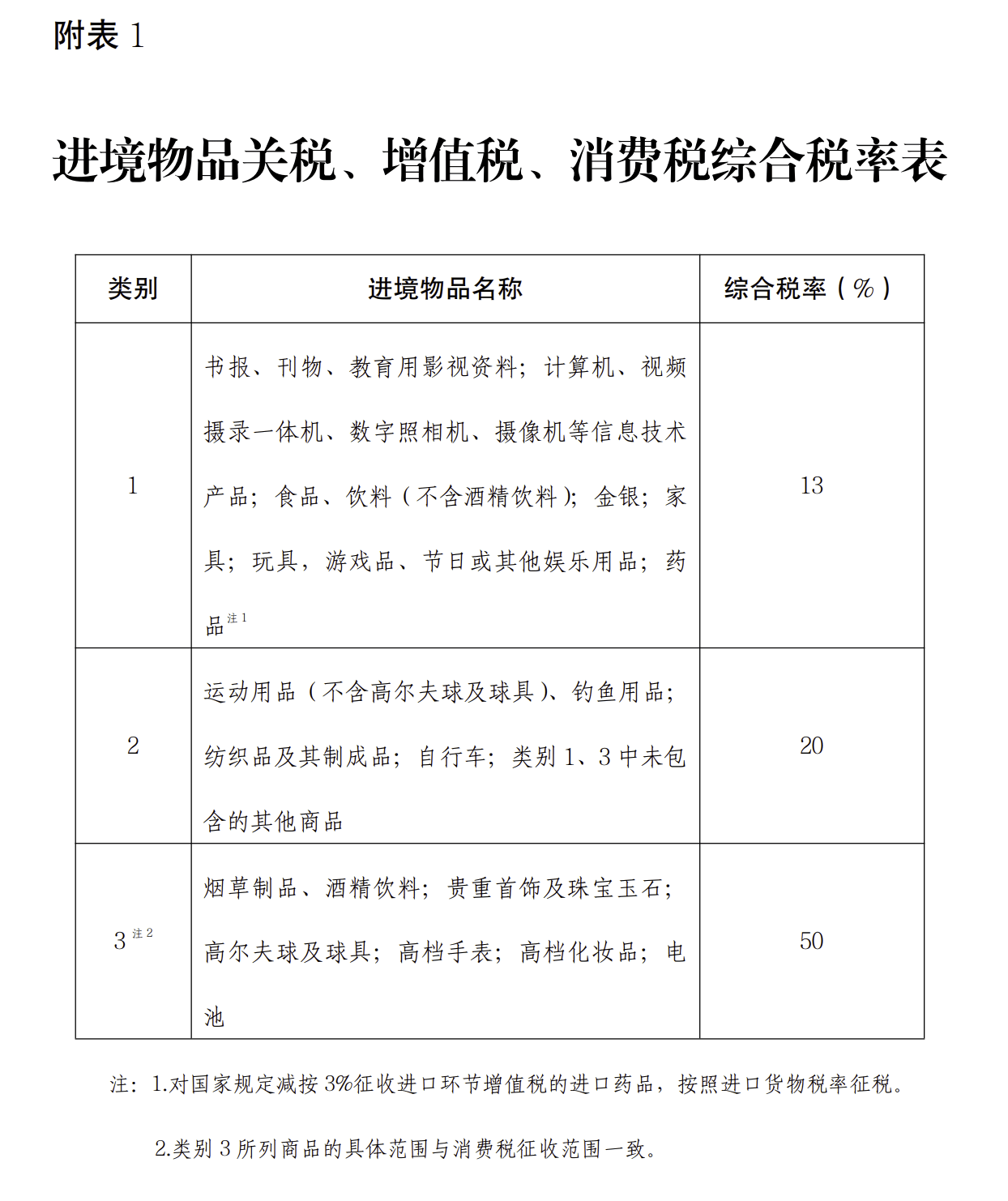
Taking the overseas shopping of digital products that I do the most as an example, the import tariff is usually 13%.
In addition, you may encounter a situation where the tariff price you calculated is different from the official tariff. This may be because the customs officials’ pricing of the imported goods is inconsistent with the price you declared."Classification Table of Imported Articles" and "Taxable Price Table of Imported Articles".
As for the subsequent solution, I haven't encountered it myself. However, as long as you submit authentic shopping receipts and payment receipts, you shouldn't encounter this problem. If you do encounter it, you can consider consulting the "Mobile Customs" mini-program.
VI. Transshipment Risks
Although you may encounter various problems when choosing a forwarding service, I personally feel that there are only two risks: lost items and returned items.
Unfortunately, I almost encountered both of these things, but fortunately I found solutions, so this can be regarded as sharing of experience and operation avoidance.
Lost items
This happened just before this video.

July 18I wanted to test whether I could buy an iPhone 13 directly from Total Wireless in Chrome's normal mode without using a virtual machine to place an order remotely. Unexpectedly, the order was successful.
Of course, I still upgraded some minor configurations of my browser, which I will share when I have time.
July 20, I filled out the warehousing declaration at the forwarding company;
July 21UPS shows that the package has been delivered
Then, there was no notification of the shipment entering the warehouse at the forwarding company's backend, and then there was a long wait... During this period, I contacted customer service several times to check the order status. First, there was a 3-working-day wait, and then another 3-working-day check... but there was still no result.
By this point, I was already mentally prepared for a lost package. Since the shipping company had just changed their address, I figured it might be a messy process. Of course, UPS losing packages is nothing new.
July 30In a last-ditch effort, I contacted Total Wireless customer service, hoping they would contact UPS and issue proof of receipt to clarify liability. If the package were truly lost, the likelihood of recovering it would be very low. However, in a surprising twist of fate, TW customer service said UPS would contact me in 15 minutes and re-deliver the package.
I even confirmed with customer service: The mail status shows that it has been signed for. Are you saying that UPS did not deliver it?
TW Customer Service: We will help you handle it. UPS will contact you and deliver it. If you have any questions, please feel free to contact us.
That's about it. I thought ending the conversation would send the chat history, but it just closed the window. So I didn't take a screenshot. This conversation has really updated my understanding of American services.
July 31, no results...
August 1, it’s actually been put into storage!
This is the entire process of a "suspected lost package." I can only say I was lucky enough to finally get my phone back. But I still have a question: if the package didn't arrive, why would UPS show it as delivered?
If it is delivered and then lost, will a new one be sent?
No matter what, there is no correct answer.
To be honest, I was browsing forums recently and saw some bad people in the United States complaining about couriers stealing cell phones, which really refreshed my perspective.
Therefore, lost items are an unavoidable issue when shopping overseas. If it is a valuable item, do not skimp on the courier fee.
In addition, in my personal opinion, the insurance provided by the shipping company is usually just for show and of little use.
Return/Destruction
As for the risk of "return", it usually will not happen if you can maintain good communication with the forwarding company, confirm whether the product supports forwarding, and the recommended express delivery route.
But when I bought an iPhone 13 and a Pixel 9a, I took the easy way out and sent them directly to China via FedEx, relying on the impression that "you can buy up to two phones." As a result, when the package was clearing customs, FedEX informed me that because the item was worth more than 2,000 yuan, I could only keep one phone and had to give up the other.
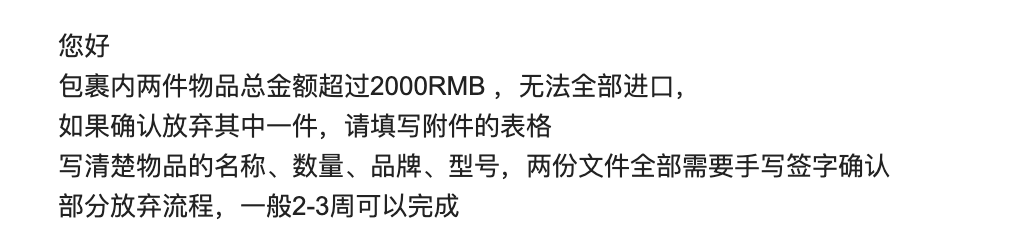
If you want to solve it, there are only two ways:
1. Find someone who has returned to Beijing from the United States within the past week, provide their passport and itinerary, and clear customs as a personal belongings;
2. Provide 3C certification and clear customs as imported goods. As for how to get 3C certification? Maybe you can look at Taobao...
Although the process was tortuous, I finally got the two mobile phones.
Although this matter sounds simple, it actually took many communications with the FedEx staff before she provided the two solutions mentioned above. The second solution, in particular, was quite obscure.
Later, I changed two Taobao stores before I found one that was willing to give it a try. But my personal opinion is that they all knew what was going on.
The lesson from this incident is not to act based on impressions; the experience gained is: chat more with customer service, find out the cause of the problem, and maybe you can find a solution.
Well, that’s all about “Overseas Shopping Shipment”. In this series,
Lists the transshipment usage scenarios of ordinary mail, parcels, and financial products.
We talked about residential addresses, business addresses, post office boxes, private addresses and other address types.
Talked about the skills of filling in the name and address identification code,
It talks about the entire shipping process from placing an order abroad to mailing it back to China.
The cost of basic freight, value-added services and import tariffs was analyzed.
Finally, I shared my personal solution to dealing with shipping risks such as lost and returned items.
I hope this will help you gain a better understanding of the overall framework of the forwarding company.
Of course, my personal ability is limited, so it is inevitable that there will be mistakes and omissions.
If there are any inappropriate parts, please correct them in the comment section.
If it really helped you
I hope you can subscribe to my channel
You can also comment, like, favorite, and forward
That's it, bye-bye~
